
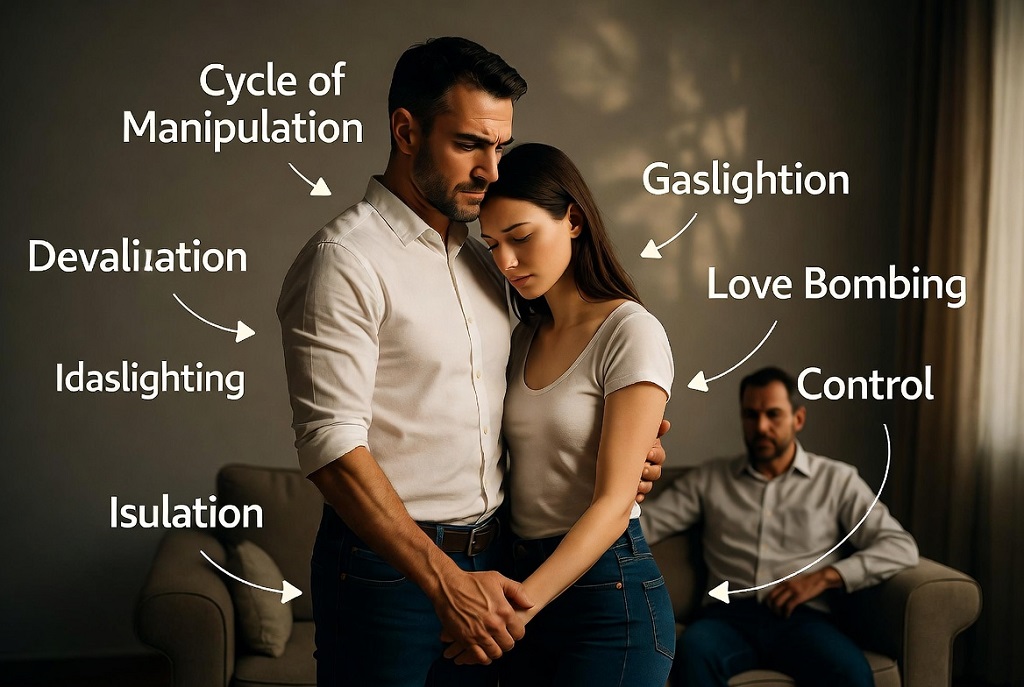
You’ve decided to leave. You’ve actually decided. You said the words to yourself in the mirror. You felt the resolve harden in your chest. This time is different. This time you mean it.
And then they call. Their voice is soft. They say they’ve been thinking about you all day. They mention a memory—something small, a joke only the two of you share. You feel the wall inside you start to crack. By the end of the call, you’re not leaving. You’re making plans for the weekend.
Later, you hang up and stare at the wall. You feel relief that the pain is over, but underneath it, there’s something else. A quiet shame. A confusion. Why can’t I just go?
This is not a failure of will. This is the architecture of a cycle designed to keep you inside it.
The Mechanism of the Cycle
An emotional manipulation cycle is not a series of random bad events. It’s a closed loop. Every part of it serves to keep you trapped. To break it, you have to understand how each phase feeds into the next.
Phase One: The Buildup
This is the phase before the rupture. There’s a tension in the air. You can feel it, but you can’t name it. They’re slightly distant, slightly sharp. You start walking on eggshells. You monitor your words. You try to be smaller, easier, so you don’t trigger the explosion.
The buildup is designed—consciously or not—to make you responsible for their emotional state. You learn to manage them. You learn that your safety depends on your performance.
What this feels like: You’re constantly scanning. You check their mood before you speak. You rehearse conversations to avoid landmines. You’re not living your life; you’re managing theirs.
Phase Two: The Rupture
It happens. An argument, a betrayal, a cold silence that lasts for days. The rupture is painful, but in a strange way, it’s also a relief. The tension has broken. Now you’re in the storm, and at least the waiting is over.
During the rupture, they may say terrible things. Things that cut to the core of who you are. Or they may say nothing at all, leaving you to drown in the silence. Either way, you are devastated. You are convinced the relationship is over.
What this feels like: You’re in free fall. The ground has disappeared. You can’t eat, can’t sleep, can’t think. Every part of you is screaming for resolution.
Phase Three: The Chase
This is the critical phase. After the rupture, there is a moment where the relationship hangs in the balance. In a healthy dynamic, this is where repair happens. In a manipulative cycle, this is where the hook is set.
They sense you pulling away. They sense the finality in your voice. And something shifts. They become the person you fell for. They’re attentive, loving, apologetic. They say the words you’ve been dying to hear. They may cry. They may make promises. They may tell you that you’re the only one who understands them, that they can’t live without you.
This is not repair. This is retrieval.
What this feels like: Relief. Overwhelming, body-wide relief. The pain is ending. They love you again. You’ve been saved. You don’t question it because you’re too grateful for the rescue.
Phase Four: The Honeymoon
You’re back. The relief is overwhelming. The love feels deeper now because it’s been tested. You think, We made it. We got through it. This is proof that we’re meant to be.
The honeymoon phase is real in its feeling, but it’s borrowed. It’s built on the relief of the rupture ending, not on genuine resolution. The underlying issue—the pattern itself—has not been addressed. It’s just been temporarily soothed.
And then, slowly, the buildup begins again. The cycle repeats.
What this feels like: You’re floating. The bad times are a distant memory. You convince yourself that this time it will last, that you’ve finally turned a corner. You don’t notice the tension beginning to build again because you’re too busy enjoying the peace.
Why the Cycle Is So Hard to Break
You stay not because you’re weak, but because you’re addicted to the honeymoon. Your brain has learned that after every rupture, there is a reward. And your brain will endure almost anything for the reward.
This is intermittent reinforcement. It’s the same principle that makes a slot machine addictive. If you won every time, it would be boring. It’s the uncertainty that hooks you—the not knowing when the payout will come. So you keep pulling the lever. You keep trying to earn the love back.
Neuroscience shows that intermittent reinforcement is more powerful than consistent reward. The unpredictability keeps your brain in a state of heightened anticipation. You’re not weak; you’re biologically wired to seek resolution, and the cycle exploits that wiring.
The Question You Stop Asking
In the cycle, you lose something essential. You lose the ability to ask a simple question: Is this relationship meeting my needs?
You’re so focused on surviving the ruptures and chasing the honeymoons that you forget to evaluate the relationship on its own terms. You’re not asking, “Am I happy?” You’re asking, “Can I make it through another week?”
The cycle narrows your vision. It makes the absence of pain feel like the presence of love.
If This Is You, Your Next Small Step Is
You cannot break the cycle by analyzing it from the inside. You need distance. Even a small distance.
For one week, try this: write down the cycle as it happens. Not with judgment, just with observation.
-
Day 1: Tension. They’re distant. I feel anxious.
-
Day 3: Rupture. Fight about [thing]. I feel devastated.
-
Day 4: Chase. They called, apologized, said they can’t live without me. I feel relief.
-
Day 7: Honeymoon. Things are good. I feel hope.
At the end of the week, look at the page. You’re not looking for meaning. You’re looking for shape. If you see the same shape repeating—buildup, rupture, chase, honeymoon—you have your answer about whether this is a cycle or a relationship.
The Exit Is in the Pattern, Not the Person
You will never leave by analyzing them. You will leave by analyzing the pattern. They will always have a reason. They will always have an apology. They will always have a moment of sweetness that makes you doubt yourself. That’s the design.
To break the cycle, you have to stop looking at them and start looking at the shape of your own experience.
Ask yourself:
If I mapped the last six months, would I see growth, or would I see repetition?
Not intensity. Not love. Not passion. Repetition. Have the same fights happened? Have the same promises been broken? Have you had the same conversation about the same issue more than three times?
If the answer is yes, you are not in a relationship. You are in a loop. And loops don’t lead anywhere. They just keep turning.
The Moment of Leaving
Leaving a cycle is not like leaving a person. It’s like withdrawing from a substance. There will be withdrawal. There will be the voice that tells you to go back, that this time will be different, that you’re overreacting. That voice is not your intuition. That voice is the cycle, speaking in your own tone.
The only way out is to stop participating. Not to win the argument. Not to get the last word. Not to make them understand. Just to stop.
The silence after you leave will be loud at first. But eventually, in that silence, you will begin to hear your own voice again. And that voice, the one that’s been buried under the cycle, will tell you what you’ve always known: you were never asking for too much. You were just asking in the wrong place.
Related Explorations:
-
The Psychology of Staying Too Long in the Wrong Relationship
-
Love Bombing, Silent Treatment, and Other Control Tactics
-
What Gaslighting Really Looks Like in Modern Relationships