
Analyze Apologies. Detect Manipulation. Measure True Accountability.
Not all apologies are genuine.
Some apologize to repair harm.
Others apologize to end the conversation.
The Quillfy Apology Authenticity Evaluator is an advanced forensic apology analysis tool designed to assess whether an apology reflects genuine remorse, emotional intelligence, and accountability — or whether it contains manipulation tactics such as gaslighting, blame-shifting, minimization, or emotional invalidation.
This tool transforms emotional doubt into structured clarity.
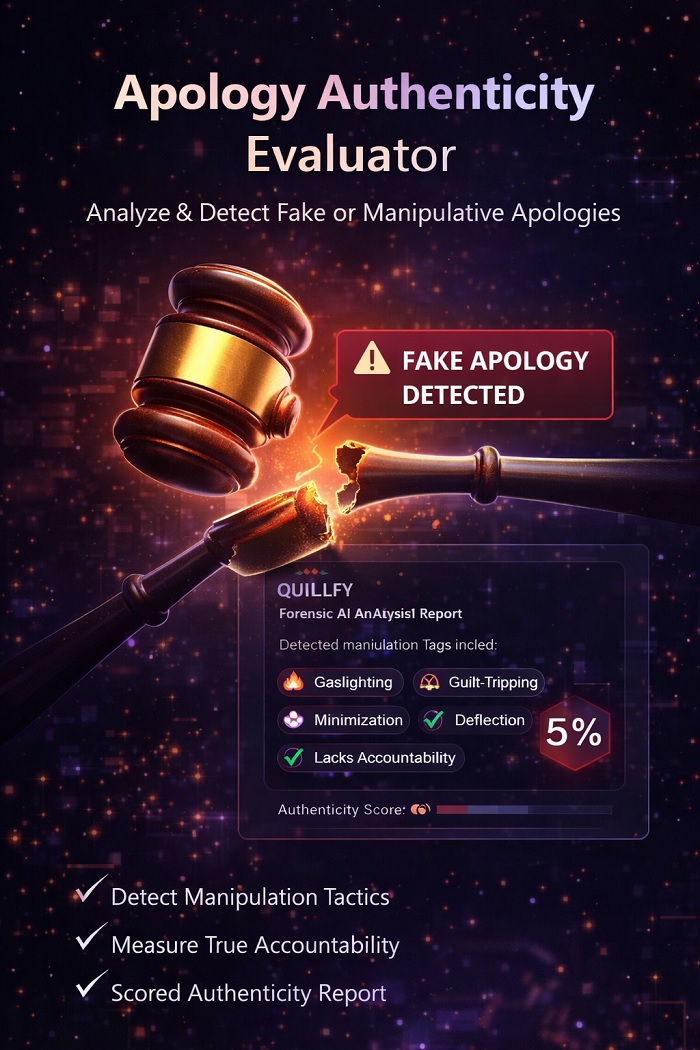
The Apology Authenticity Evaluator analyzes apology messages using structured psychological and linguistic pattern recognition.
- You paste the apology text.
- You provide the relationship context.
- The system evaluates the apology across multiple authenticity dimensions.
You receive a detailed, sectioned forensic-style report that answers one core question:
Is this apology real — or strategic?

This tool is ideal for individuals who:
- Feel unsure whether an apology is genuine
- Suspect emotional manipulation in relationships
- Want objective clarity before reconciliation
- Experience repeated “sorry” cycles without change
- Need structured analysis before making a relationship decision
- Value psychological insight over guesswork
It works for romantic relationships, friendships, family dynamics, and professional communication.
The system examines:
- Word choice precision vs vagueness
- Conditional language (“if you felt…”)
- Blame-shifting phrasing
- Minimization tactics
- Defensive sentence structures
- Implied “but/however” negations
- Emotional invalidation markers
This is not surface-level sentiment analysis.
It evaluates the structure of the apology itself.
Each apology receives a measurable authenticity score based on weighted criteria, including:
- Accountability (30%)
- Manipulation Detection (30%)
- Emotional Depth (20%)
- Deflection Avoidance (20%)
The system provides a final percentage score that reflects how authentic and responsible the apology truly is.
This replaces emotional confusion with measurable clarity.
The tool evaluates whether the apology includes:
- Clear acknowledgment of wrongdoing
- Specific mention of the harmful action
- Ownership using responsible “I” statements
- Absence of victim-blaming language
- Avoidance of conditional apology phrasing
- Commitment to behavioral change
If accountability is absent, the report explains why.
The evaluator detects classic non-apology patterns, including:
- “I’m sorry you feel that way” structures
- Gaslighting indicators
- Guilt-tripping statements
- Victim-blaming generalizations
- Minimization of harm
- Emotional dismissal
- Conversation shutdown attempts (“Can we just move on?”)
Each detected manipulation tactic is explained clearly, with psychological interpretation and potential impact on reconciliation.
The report evaluates:
- Presence or absence of empathy
- Emotional vocabulary depth
- Understanding of impact
- Validation of recipient’s feelings
- Emotional maturity indicators
This section helps users understand whether the apology reflects growth or defensiveness.
The system extracts specific high-risk phrases and assigns severity levels:
High 🔴
Medium 🟡
Each red flag includes:
- Exact text evidence
- Psychological explanation
- Potential reconciliation impact
This section is especially powerful because it links language to psychological consequence.
The goal is clarity.
Beyond authenticity scoring, the report evaluates:
- Risk of false reconciliation
- Likelihood of repeat behavior
- Recommended caution level
- Boundary-setting guidance
This helps users think strategically, not emotionally.
The report includes a structured comparison showing the following:
What a truly accountable apology would include:
- Specific acknowledgment
- Genuine remorse
- Empathy
- Full responsibility
- Clear commitment to change
- Respectful request for forgiveness
It also highlights exactly which of these elements are missing.
This section educates users on what healthy communication looks like.
The system provides measurable clarity metrics such as the following:
- Number of manipulation indicators detected
- Number of accountability elements present
- Deflection attempt count
- Emotional depth score (1–10)
- Specificity score (1–10)
Numbers reduce emotional fog.
How It Works
Step 1: Paste the apology text.
Step 2: Provide relationship context and severity level.
Step 3: Receive a structured forensic apology authenticity report.
Longer, detailed inputs produce deeper analysis accuracy.
All analysis remains confidential.
Why Quillfy Built This
At Quillfy, we believe clarity is more powerful than comfort.
Many people accept apologies that sound polite — but lack accountability.
We created this tool because:
– Words can disguise intent.
– Language can conceal responsibility.
– Politeness can hide manipulation.
Instead of telling users what to feel, we provide structured analysis so they can think clearly and decide wisely.
We do not encourage conflict.
We encourage clarity.