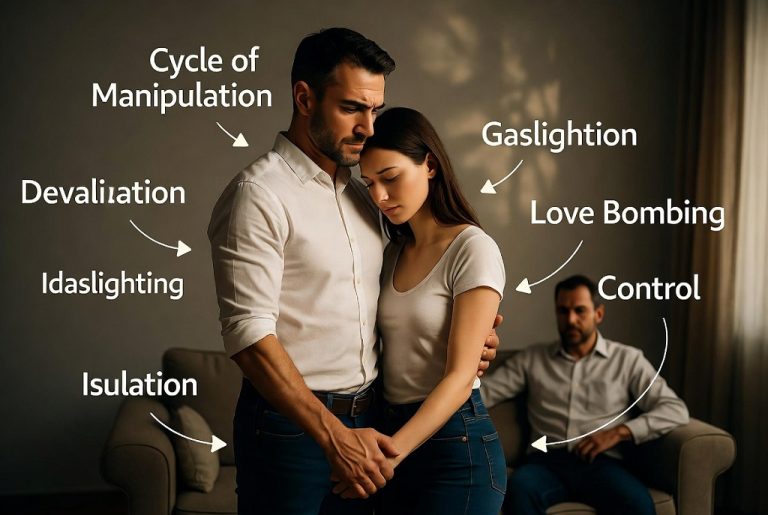

You’re lying awake again. The clock says 3:17. Your partner breathes softly beside you, or maybe the bed feels empty even when they’re in it. You’ve memorized the pattern on the ceiling by now—that small crack near the light fixture, the way shadows pool in the corner.
Your mind runs its nightly tape: the thing they said last week, the silence that followed, the moment six months ago you keep circling back to. You’re trying to weigh everything—the tenderness against the exhaustion, the history against the hope. But the scale won’t tip. It just hangs there, suspended in a gray fog that’s become your permanent weather.
This isn’t a crisis with slammed doors and packed suitcases. It’s quieter. It’s the slow erosion of knowing what you know. You find yourself editing your stories before you tell them, bracing for a reaction you can predict but can’t prevent. You feel a low-grade loneliness even when you’re not alone. The question should I stay or should I go has stopped feeling like drama and started feeling like a math problem you can’t solve.
I’ve sat with hundreds of people in this exact place. And here’s what I’ve learned: the challenge isn’t finding the right answer. The challenge is that you’ve been asking the wrong question.
Before We Go Further
If you are experiencing physical violence, threats, or coercive control—if you’re afraid of what might happen when your partner reads this, or if leaving feels dangerous in a way that makes your stomach drop—your situation requires different guidance. Safety comes before clarity. Please reach out to the National Domestic Violence Hotline at 800-799-7233 or a trusted advocate. They understand. This article will be here, but your safety cannot wait.
Why Your Mind Won’t Let You Decide
Here’s what most people do when they’re stuck: they try to gather more evidence. They start monitoring. They analyze text messages for tone, catalog small disappointments, wait for the smoking gun—one clear, undeniable piece of proof that the relationship is over. They want the pain to be so sharp, the reason so definitive, that the decision makes itself.
But that’s not how long-term ambiguity works. It doesn’t produce clean breaks. It produces a slow bleed.
What you’re actually experiencing isn’t a lack of information. It’s a collision between two different psychological systems that speak different languages. Your analytical mind is building spreadsheets of pros and cons. Meanwhile, your attachment system—the ancient part of your brain designed to keep you connected to others for survival—is flooding you with panic at the thought of leaving. Neuroscience shows that relationship separation activates the same brain regions as physical pain. This isn’t weakness. It’s wiring.
Until you learn to separate these signals, clarity will remain out of reach.
The Framework: Three Ways of Being Stuck
The feeling of being trapped in indecision usually falls into one of three categories. Most people recognize pieces of themselves in more than one—that’s not confusion, it’s the reality of complex relationships. The goal isn’t to force yourself into a single box. It’s to understand which pattern is dominating your emotional landscape right now.
Category One: The Deterioration Dilemma
The Foundation Is Crumbling
This is the most straightforward category, though not the easiest to accept. Here, the relationship’s core structure is failing. This isn’t about a rough patch; it’s about a fundamental shift in safety, respect, or functionality.
What This Feels Like Day to Day:
You walk on eggshells but pretend the eggs aren’t there. You rehearse conversations before having them, trying to find the right words that won’t trigger an explosion or withdrawal. When you do share something vulnerable—a fear, a need, a small hurt—it either gets used later or disappears into a void. You’ve stopped expecting to feel truly seen.
The laughter still happens sometimes. You still have inside jokes, familiar routines, moments of genuine warmth. But they feel like islands in a rising sea. You’re starting to realize that the exceptions are keeping you tethered to a pattern that isn’t working.
The Diagnostic Question:
If this relationship were a house, are you discussing paint colors, or are you realizing the foundation is cracked? A cracked foundation can sometimes be repaired, but only if both people acknowledge it and commit to the expensive, difficult work. If your partner won’t even look at the crack—if they minimize it, blame you for noticing it, or promise to fix it while doing nothing—you’re not in a repair process. You’re just living in an unsafe structure.
If This Is You, Your Next Small Step Is:
Choose one conversation you’ve been avoiding—not the biggest one, not the “future of the relationship” talk, but a medium-sized concern. Share it with your partner using this script: “I’ve been hesitant to bring this up because I’m afraid of how you’ll respond. But I need to know if we can talk about hard things together. Can we try?”
Their response will tell you more than a hundred sleepless nights of analysis.
Category Two: The Incompatibility Gridlock
You’re Aligned on Love, Not on Life
This is often the cruelest category because the love might still be real. There may be no villain, no betrayal—just a quiet, devastating realization that your paths don’t align. This tends to surface around core values, life goals, or essential needs that cannot be negotiated away.
What This Feels Like Day to Day:
The same arguments keep happening, but they’re never really about what they seem to be about. You fight about money, but underneath it’s security versus freedom. You fight about family, but underneath it’s autonomy versus togetherness. You’ve both become expert at translating your real needs into safer, smaller complaints because the real needs feel too big to say out loud.
You might catch yourself thinking: If they would just understand me better, we’d be fine. But they do understand you. That’s the problem. You understand each other perfectly. You just want different things.
The Diagnostic Question:
If you took love and attachment off the table—if you could press a button and remove the fear of being alone, the guilt of hurting them, the weight of your shared history—would you choose this person as your partner for the life you actually want to live? Love makes incompatibility tolerable in the short term. It rarely erases it in the long term.
If This Is You, Your Next Small Step Is:
Write down three non-negotiables for your life—things that, if you don’t have them, you will eventually resent yourself for sacrificing. Not what you could live with. What you need. Then ask yourself: does this relationship make those things more possible or less?
You don’t have to share this list yet. Just let yourself look at it.
Category Three: The Fear Trap
You’re Staying to Avoid a Feeling
This category has less to do with the relationship itself and more to do with what leaving would mean for you. The relationship may be mediocre or draining, but it feels safer than the unknown.
What This Feels Like Day to Day:
You’re not happy, but you’re also not unhappy enough to leave. You tell yourself you’re staying out of loyalty or hope, but underneath, there’s a low hum of dread that you’ve learned to tune out. You make decisions based on what will cause the least disruption, the least conflict, the least pain for everyone except yourself.
You might notice patterns of walking on eggshells that have been with you since childhood, or a deep terror of being alone that predates this relationship by decades. The thought of leaving triggers not just sadness but a kind of panicked unraveling—as if you might not survive the separation.
For Those in Cyclical Patterns:
If your relationship swings between intense connection and painful disconnection—if the highs feel like salvation and the lows feel like abandonment—you may be experiencing something called trauma bonding. This is a biological response to intermittent reinforcement. The brain becomes addicted to the “good times” because they break the pattern of the bad times. Leaving feels impossible not because the relationship is good, but because your nervous system has been trained to seek relief from the very person causing the pain.
The Diagnostic Question:
If you were guaranteed that you would be emotionally, physically, and financially okay six months from now—and that your partner would be okay too—would your decision change? If the answer is yes, you’re not staying because of love. You’re staying because leaving feels too dangerous.
If This Is You, Your Next Small Step Is:
For one week, practice imagining your future without the relationship for five minutes each day. Don’t make any decisions. Just let yourself sit with the image. Notice where fear shows up in your body. Notice if grief eventually arrives—and how it feels different from fear. Grief is heavy but grounded. Fear is tight and frantic. You need to learn the difference.
How Your Attachment Style Hijacks Clarity
Your childhood taught you how to love, often without your permission. If you had caregivers who were inconsistently available, you may have developed an anxious attachment style—meaning you’re hypervigilant to threat of loss, quick to blame yourself, and prone to clinging tighter when the relationship feels unstable. In each of the three categories above, anxiety will amplify the noise. It will tell you that leaving means dying, that you’ll never find anyone else, that every problem is your fault.
If you had caregivers who were emotionally unavailable or overwhelmed by your needs, you may have developed an avoidant attachment style—meaning you’re prone to minimizing problems, distancing when things get close, and doubting whether anyone can truly meet your needs. In these categories, avoidance will whisper that all relationships are disappointing, that you’re better off alone, that the problem is always them.
Neither of these voices is the truth. They’re survival strategies that have outlived their usefulness. The work is to hear them without letting them drive.
Why Your Brain Lies to You About This Relationship
Even after you identify your category, several cognitive biases will actively work against your clarity.
The Sunk Cost Fallacy:
You’ve invested years, emotions, a home, a shared life. The thought of walking away from that investment feels like admitting total failure. But in relationships, past costs should not dictate future decisions. The question isn’t what have I put in? It’s where is this going from here? A ship that’s sailed in the wrong direction for a thousand miles still needs to turn around.
The “Good Times” Interference:
Your brain is wired to remember peak emotional moments and recent events. A single genuinely warm evening can overwrite weeks of quiet discontent. This isn’t denial; it’s a memory distortion. You’re using a lovely dinner to justify ignoring a pattern of emotional unavailability. The exceptions are not the rule, but your brain will try to convince you they are.
Fear-Driven Attachment:
If you have an anxious attachment style, the threat of separation can trigger a powerful panic response. Your nervous system interprets the potential loss of the relationship as a threat to survival. It will flood you with longing, nostalgia, and doubt—pushing you to cling tighter, even to something that isn’t working. The intensity of this feeling does not mean the relationship is right. It means your biology is doing its job.
Two Exercises That Cut Through the Fog
You won’t find certainty. Certainty is a luxury that rarely exists in complex human relationships. What you can find is conviction—a sense that you made the best decision with the information and self-awareness you had.
Exercise One: The Seven-Day Pattern Journal
For one week, observe your relationship as if you were a neutral third party studying human behavior. Don’t judge. Just note. After each significant interaction, ask yourself these three questions and write down the answers:
-
After that interaction, did I feel more energized or more drained?
-
Did I feel seen for who I actually am, or did I feel like I was performing?
-
If this interaction were the only data point I had about my relationship, what would it tell me?
At the end of the week, don’t count the good versus bad. Look for the pattern. We often stay for the exceptions while our daily reality is the trend.
Exercise Two: Two Columns
Draw a line down the middle of a page. On the left, write: The Story I Tell Myself. On the right, write: What Is Actually Happening.
Be honest in the left column. He loves me, he’s just stressed. She doesn’t mean to dismiss me, she’s overwhelmed. If I could just communicate better, we’d be fine. The good times prove it’s worth staying.
Then, in the right column, write only what a camera would record. He didn’t ask about my day. She looked at her phone while I was talking. I felt afraid to bring up my need. This is the fourth time this month I’ve cried alone.
The gap between the two columns is where clarity lives.
What If Practical Barriers Are the Real Problem?
Sometimes the heart knows the answer, but logistics make it impossible to move. You share children, finances, a home, a community. Leaving would mean upheaval that feels unthinkable.
Let me be direct with you: practical barriers are real. They matter. They deserve compassion and careful planning. But they are not the same as a reason to stay. If you knew with certainty that leaving was right for your soul, would you find a way to navigate the logistics? Would you figure out co-parenting, financial separation, housing? You would. It would be hard—brutally hard—but you would do it.
The question isn’t whether the barriers exist. It’s whether you’re using them to avoid a decision you’re afraid to make.
If logistics are genuinely the primary obstacle, shift your focus from should I stay or go to how could I make leaving sustainable? Talk to a financial counselor, a lawyer, a trusted friend who can help you problem-solve. You may find that what feels impossible becomes manageable with the right support.
Having the Conversation: Three Scripts
If you’re still unsure, sometimes the most clarifying step is to speak the unspeakable—carefully, with intention.
To your partner, if you want to test the possibility of repair:
“I need to talk about something I’ve been scared to say. I’ve been feeling disconnected and uncertain about us. I don’t want to make any decisions from a place of fear. But I need to know if we’re both willing to look honestly at what’s not working and try to understand it together.”
To yourself, when fear is loudest:
“I am allowed to want a life that feels good, not just tolerable. My fear of leaving is not the same as proof that I should stay. I can feel terrified and still be making the right choice.”
To a trusted friend (not one who will just tell you what you want to hear):
“I’m going to tell you what’s happening without editing it. I don’t need you to fix it or take sides. I need you to listen and tell me if you notice any gaps between what I’m saying and what seems true.”
Taking Accountability Without Taking All the Blame
Before you make any final decision, it’s worth examining your own contributions to the dynamic. This is not about blaming yourself. It’s about ensuring you don’t carry unexamined patterns into your next chapter.
Ask yourself honestly:
-
Did I avoid hard conversations because conflict felt unsafe?
-
Did I expect my partner to read my mind rather than stating my needs clearly?
-
Did I stop communicating what I truly wanted because I’d rather keep the peace than risk rejection?
-
Did I stay past my own knowing, hoping they would change?
Notice the difference between owning your part and taking responsibility for everything. Your contribution to a dynamic does not erase their contribution. It’s not your fault that the relationship is struggling. But it is your responsibility to understand your role so you don’t repeat it.
Here’s the deeper question: What pattern will I carry forward if I don’t examine my own behavior? If you leave without looking inward, you may find yourself in the same dynamic with a different person. If you stay without looking inward, you may repeat the same dances that brought you here.
Making the Decision Without Regret
You’ve done the work. You’ve identified your category, separated fear from intuition, mapped the patterns, examined your own role. Now comes the moment of choosing.
A decision to stay or leave should be based on an honest assessment of the pattern, not the potential. We can always imagine how things could be. The question is what is.
If you see a relationship where:
-
Both people are willing to look at the cracks
-
Incompatibilities are named and addressed with honesty
-
Fear is acknowledged but not driving the bus
-
Repair is actually happening, not just promised
Then staying is a conscious choice, not a default. You can stay with intention. You can stay and work.
But if you see:
-
A pattern of deterioration you cannot halt
-
An incompatibility so fundamental that bridging it would require one of you to stop being who you are
-
A fear so large it’s the only thing holding you there
Then you have your answer. The time to leave is not when the pain becomes unbearable. It’s when you realize the pain of staying has become greater than the fear of leaving.
The Clarity You’ll Carry
You’re still lying in bed. The ceiling still has that crack. Your partner may still be breathing beside you, or the bed may still feel empty. But something has shifted.
You’re no longer searching for a smoking gun that will never come. You’re no longer waiting for certainty that doesn’t exist in human love. You’re looking at the pattern, not the exceptions. You’re hearing the difference between fear and intuition. You’re holding both your own responsibility and their contribution, without collapsing into blame or self-flagellation.
Clarity isn’t a thunderbolt. It’s not a neon sign. It’s the quiet knowing that you’ve done the work, that you’ve looked honestly, that you’re making the best decision with the information and self-awareness you have. It’s the ability to live with your choice—and yourself—without regret.
You may still feel grief. Grief is not a sign you made the wrong choice. Grief is a sign you loved something real, even if it couldn’t last. Let grief be grief. Let fear be fear. Let clarity be the quiet thread that holds them both.
And when you’re ready, turn toward the ceiling one last time. Not searching for answers now—just breathing. You have what you need. You’ve had it all along.
Related Explorations:
-
Understanding Your Attachment Style
-
The Difference Between Love and Pattern Recognition
-
Navigating Practical Barriers to Leaving
-
What Repair Actually Looks Like in Practice